NDIS Support Coordination Explained: Everything You Need to Know
If you’ve recently received your NDIS plan or you’re still trying to wrap your head around one that’s been sitting on your kitchen table for a few weeks then you’re not alone. The NDIS is a genuinely life-changing scheme, but let’s be honest: it can also feel like learning a second language.
That’s exactly where support coordination comes in.
Whether you’re a participant, a parent or carer, or simply someone trying to understand the system, this guide walks you through everything you need to know about NDIS support coordination. Here you will get to know what it is, the three levels available, who’s eligible, how to find a good support coordinator, and what’s changed recently. Just the information you actually need.
What Is NDIS Support Coordination?
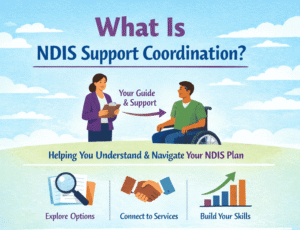
Support coordination is a funded support under the NDIS that helps participants understand, implement, and get the most out of their NDIS plan. It sits within your Capacity Building budget and is classified as a stated support meaning the funding set aside for it can only be used for that purpose.
Think of your support coordinator as a knowledgeable guide by your side. They don’t make decisions for you. Rather they help you understand your choices, connect you with the right services, and build your confidence to manage your own supports over time. The long-term goal is always your independence, not ongoing reliance on a coordinator.
According to the NDIS, a support coordinator supports the participant to understand and implement supports included in their plan. They link the participant to providers and other community and government services, and help the participant build skills and direction.
It’s important to understand that support coordination is not the same as case management. It’s not about someone taking over the running of your life. It’s about giving you the tools, knowledge, and connections to take control of it yourself.
Who Is Support Coordination For?
Not every NDIS participant will have support coordination included in their plan and that’s okay. Most NDIS participants are supported to implement their plan through an NDIS partner in the community, such as Early Childhood Early Intervention (ECEI) partners or Local Area Coordinators (LACs). Support coordination is for NDIS participants who have support needs that exceed the role of an ECEI or LAC partner.
In practice, funding for support coordination is more likely to be included in your plan if you:
- Are new to the NDIS and need help getting started
- Have a complex disability or multiple diagnoses
- Are connected to other service systems such as housing, mental health, or the justice system
- Have limited informal support networks (such as family or friends who can help)
- Are in a crisis or unstable situation
- Need to coordinate a large number of providers and services
Funding is based on your individual needs and what is considered reasonable and necessary. If it’s not currently in your plan, you can ask your LAC about whether it might be included at your next plan review.
The 3 Levels of NDIS Support Coordination
One of the most important things to understand is that support coordination isn’t one-size-fits-all. There are three levels of support coordination that can be included in your plan. Each is designed for different circumstances and levels of complexity.
Level 1 – Support Connection
This is the entry-level tier. Support Connection is designed to build your ability to connect with informal, community, and funded supports. They enable you to get the most out of your plan and pursue your goals.
It’s typically a short-term support, ideal for someone who is new to the NDIS and mostly needs help getting their initial services set up. You’ll get some guidance on understanding your plan, connecting with providers, and taking those first confident steps. After that you’re on your way.
Good for: First-time NDIS participants with straightforward needs and one or two services to coordinate.
Level 2 – Support Coordination (Coordination of Supports)
This is the most commonly funded level, particularly for participants managing multiple services or living with psychosocial disability. Support Coordination assists you to build the skills you need to understand and use your plan. A support coordinator will work with you to ensure a mix of supports are used to increase your capacity to maintain relationships, manage service delivery tasks, live more independently, and be included in your community.
A Level 2 coordinator provides ongoing support. They help you coordinate therapists, support workers, community access services, and anything else in your plan. They monitor your budget, help resolve any issues with providers, prepare you for plan reviews, and generally ensure your whole support ecosystem is working together.
Good for: Participants with moderate to significant complexity who are managing multiple providers or services.
Level 3 – Specialist Support Coordination
This is the highest and most intensive level. Specialist Support Coordination is for people whose situations are more complex and who need specialist support. A Specialist Support Coordinator will assist participants to manage challenges in their support environment and ensure a consistent delivery of service.
Specialist Support Coordinators typically hold qualifications in fields like social work, psychology, occupational therapy, or other allied health disciplines. Specialist support coordination is usually short-term, intensive support for participants who have extremely high needs or are in high-risk, complex environments. For example, participants leaving the justice system or a mental health facility.
Good for: Participants in crisis situations, those with multiple intersecting service systems (housing, justice, acute health), or those facing serious safety concerns.
Can You Have More Than One Level?
Yes and it’s more common than many people realise. Depending on a participant’s circumstances, they may have Specialist Support Coordination (Level 3) as well as Support Coordination (Level 2) stated in their current plan. This could be used for participants with immediate barriers who also need support coordination for the remainder of their plan.
Where Does Support Coordination Funding Sit in Your Plan?
Support coordination is funded through your Capacity Building budget, specifically under the Support Coordination and Plan Management category (updated in October 2024 under NDIS reforms). It is a stated support, which means you can’t use the funding set aside for support coordination for any other support.
If your plan describes the level of support coordination funded, you can only purchase that level. However, if your plan does not describe the level of support coordination funded, you can choose to purchase the level of support coordination that suits your needs.
Pricing for support coordination is set by the NDIA. As of the 2025-26 pricing arrangements, Level 1 Support Connection rates increased to approximately $64.19/hour, while Level 2 and Level 3 rates were maintained at 2024–25 caps.
What Does a Support Coordinator Actually Do?
Here’s where things get practical. A good support coordinator is genuinely one of the most valuable people in your NDIS journey. Their role goes well beyond just finding you providers. They are expected to:
- Help you understand your plan. Breaking down budget categories, explaining what each funding type can and can’t be used for and making sure you actually know what you’re working with.
- Connect you to providers. Finding registered and unregistered service providers that suit your goals, preferences, and location whether that’s a physio, a support worker, a community program, or anything in between.
- Coordinate your services. Making sure all the different providers you’re working with are on the same page and that your support ecosystem functions as a coherent whole rather than a disconnected collection of services.
- Monitor your budget. Keeping an eye on how your funding is being used so nothing runs out unexpectedly and making sure providers are charging correctly.
- Help you prepare for plan reviews. Supporting you to gather evidence, articulate your goals and progress and go into your review feeling prepared and confident.
- Advocate for you when things go wrong. If a provider isn’t delivering on their service agreement, or if something needs to escalate, your support coordinator is in your corner.
- Build your independence. The ultimate goal of support coordination is to reduce your reliance on a coordinator over time by building your skills and confidence to manage your own supports.
Your Right to Choose Your Support Coordinator
This one is worth saying loudly: you have the right to choose your own support coordinator, and you can change them at any time.
A participant can choose their support coordinator. Participants can connect with support coordinators by using a request for service, which includes information about the participant’s goals, needs and circumstances.
You can find support coordinators through:
- The NDIS Provider Finder tool on the NDIS website
- Recommendations from your LAC or NDIS planner
- Word of mouth from other participants or carers
- Disability advocacy organisations
- Direct outreach to providers in your local area
- Contacting us
When you’re shopping around for a coordinator, don’t be afraid to ask questions. A good support coordinator will welcome them. Ask about their experience with your disability type, their caseload size, how often they check in with you and whether they also offer other services that could create a conflict of interest.
Independent vs. Non-Independent Support Coordinators
This is a distinction that doesn’t get talked about enough. Some organisations both provide support coordination and deliver other NDIS services like support workers or therapy. In these cases, there’s a potential conflict of interest. Your coordinator might, consciously or not, steer you towards their own organisation’s services rather than finding the best fit for you.
An independent support coordinator only provides coordination services. They don’t benefit financially from the providers they recommend, which means their advice is genuinely participant-first.
It’s not that non-independent coordinators can’t do a great job, many absolutely do. But it’s worth asking upfront and understanding where any potential conflicts might lie.
Registered vs. Unregistered Providers
Support coordinators can operate as either registered or unregistered NDIS providers, and understanding the difference matters.
Participants whose plan is managed by the National Disability Insurance Agency (NDIA) can only receive support from a registered NDIS provider. If you’re agency-managed, this is something to be aware of when choosing your coordinator.
If your plan is self-managed or plan-managed, you have more flexibility & you can work with both registered and unregistered providers.
To deliver support coordination as a registered provider, organisations must apply for registration under the relevant registration group with the NDIS Quality and Safeguards Commission and meet the applicable practice standards.
It’s also worth noting that in December 2025, the NDIS Commission paused its work on mandatory registration reforms for support coordinators. The NDIS Commission had recently consulted on and considered mandatory registration for support coordinators, but in December 2025, this reform work was paused. So the current registration landscape remains voluntary for many providers. Another reason to do your due diligence when choosing someone to work with.
How to Get Support Coordination Added to Your Plan
If support coordination isn’t currently in your plan but you think it should be, here’s how to go about requesting it.
- At your next plan review or reassessment: This is the most straightforward path. Raise it with your NDIS planner or LAC and come prepared with supporting evidence i.e. reports or letters from allied health professionals, your GP, a social worker or current service providers that clearly explain the challenges you’re facing and why a support coordinator would help.
- By requesting a Change of Circumstances review: If your situation has changed significantly since your last plan, maybe you’ve moved, your condition has progressed, or you’ve lost informal support networks then you can request an unscheduled review by submitting a Change of Circumstances form to the NDIA.
- What evidence helps: Documentation that describes the complexity of your support needs, any risks to your safety or wellbeing, how many services you need to manage, and the barriers you’re facing in using your plan effectively. Be specific and concrete wherever possible.
Support Coordinators and Safeguarding
It’s worth knowing that your support coordinator plays an important role in your safety, not just your logistics. Support coordinators play an important part in safeguarding a participant’s wellbeing. They will often be the first to become aware of any concerns about the quality and safety of a participant’s supports and services.
All NDIS providers and workers that are registered or not are bound by the NDIS Code of Conduct, which includes an obligation to promote the safety of participants. If your support coordinator ever raises concerns about a provider or a situation, take it seriously. Equally, if you have concerns about the quality or safety of your own support coordination, you have the right to raise them.
You can make a complaint about a support coordinator to the NDIS Quality and Safeguards Commission at any time.
How to Change Your Support Coordinator
Changing support coordinators is your right and it shouldn’t be a difficult process. If things aren’t working whether that’s a personality clash, a communication breakdown, or simply feeling like you’re not getting the support you need then it’s okay to make a change.
Here’s how the process typically works:
- Notify your current support coordinator that you’d like to end the arrangement. They are required to provide a transition report with an agreed end date to ensure continuity of service.
- Find a new support coordinator that’s a good fit for your needs.
- Once the transition is confirmed, end the existing service booking so the new coordinator can set up their service agreement and booking.
- If you’re plan-managed, let your plan manager know about the change.
A good outgoing coordinator will make this process as smooth as possible for you. If they don’t, that tells you something important.
Questions to Ask When Choosing a Support Coordinator
Finding the right support coordinator can make a huge difference to your NDIS experience. Here are some useful questions to help you find someone who’s genuinely the right fit:
- What experience do you have supporting people with my type of disability?
- How many participants do you currently support? (If it’s very high, you might not get the attention you deserve.)
- Do you also provide other NDIS services, and how do you manage potential conflicts of interest?
- Are you a registered NDIS provider?
- How often will we meet or check in?
- What does your process look like when something goes wrong with a provider?
- How will you help me build my own confidence and capacity over time?
- Can I speak to any current or former participants you’ve supported?
Trust your gut, too. Support coordination is a relationship and you want to feel heard, respected, and genuinely supported, not just processed.
Support Coordination vs. Plan Management: What’s the Difference?
These two roles are often confused, but they’re quite different.
A support coordinator helps you understand your plan, find providers, coordinate services, and build your skills. Their focus is on the implementation of your plan.
A plan manager handles the financial side paying your provider invoices, tracking your budgets, and dealing with the administrative paperwork. Their focus is on the financial management of your plan.
Some participants have both funded in their plan, which can be a powerful combination. Others may have one but not the other. If you’re unsure which you have or need, your LAC or NDIS planner can help clarify.
Frequently Asked Questions
Is support coordination automatically included in my NDIS plan?
No. It’s assessed on an individual basis and must be considered reasonable and necessary based on your circumstances. Not every participant will have it in their plan.
Can I have both a support coordinator and a plan manager?
Yes, and many participants do. They serve different functions as coordination vs. financial management and can work very well together.
Can I change my support coordinator?
Absolutely. You can change at any time. There’s no lock-in, and it shouldn’t be complicated. Your new coordinator can help guide you through the transition.
What if support coordination isn’t working for me?
If you’re not getting value from your coordinator, talk to them first. If that doesn’t resolve things, you have every right to find someone else. You can also contact the NDIS Quality and Safeguards Commission if you have concerns about conduct or quality of service.
Do I have to use a registered support coordinator?
Only if your plan is NDIA-managed. If you’re plan-managed or self-managed, you have the flexibility to work with registered or unregistered providers.
How much does support coordination cost?
The cost is covered by your NDIS plan as it comes out of your Capacity Building budget. You don’t pay out of pocket for services covered by your plan.
Do you provide Support Coordination Service?
Yes, Axis Support Coordination can support you in coordinating your NDIS Plan through the entire process. We provide all 3 levels of support coordination services. Contact us for more.
Final Thoughts
Navigating the NDIS doesn’t have to feel like going it alone. Support coordination exists because the system can be genuinely complex and there’s no shame in needing help to make the most of it. In fact, getting good support coordination is often the difference between a plan that sits in a drawer and one that actually transforms everyday life.
Whether you’re just starting out with Level 1 Support Connection, managing a busy web of services with a Level 2 coordinator, or navigating a complex and high-risk situation with a Specialist Support Coordinator – the right support is out there.
Know your rights, ask good questions, and don’t settle for a coordinator who isn’t giving you the time and attention you deserve. Your NDIS plan is there for you and so is the support to help you use it.
For the most up-to-date information, visit the official NDIS website at ndis.gov.au or speak with your Local Area Coordinator (LAC).